Why Your Church Needs a Mobile App in 2026 (And How to Choose)
Summary
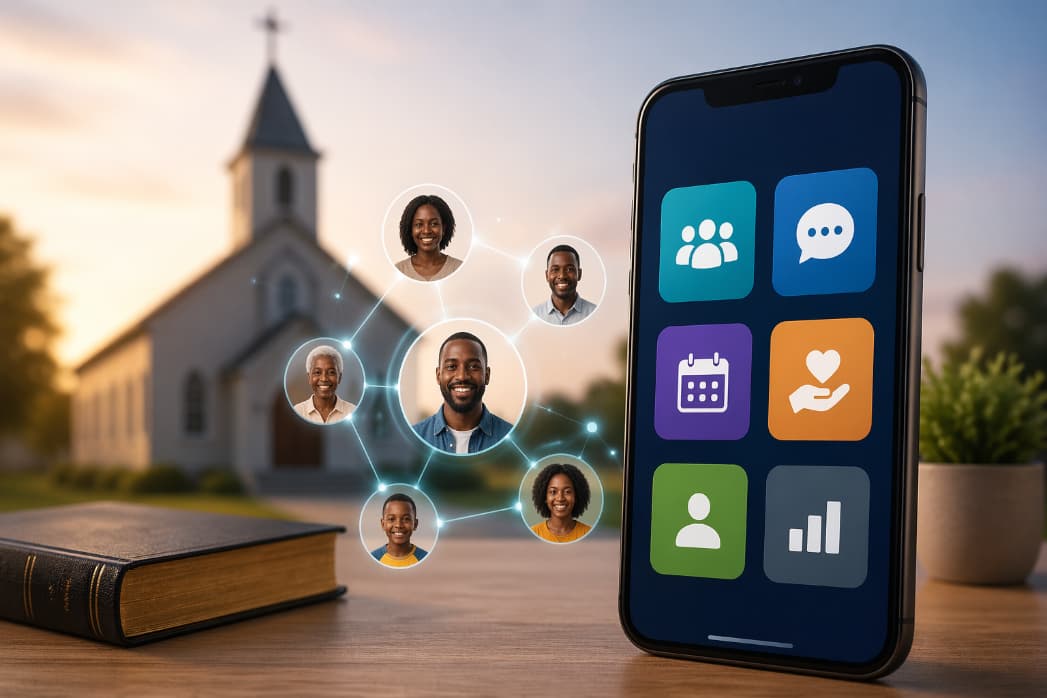
Your members are on their phones every day — but most churches only connect with them on Sunday. A church management system with mobile app changes that. This guide breaks down why mobile-first ministry matters in 2026, what you lose without it, and how to choose the right platform for your church.
Your members are on their phones — constantly. Pew Research Center reports that nearly 98% of Americans own a smartphone, and four in ten say they are online almost constantly. If your church still relies on Sunday bulletins, group texts, and email chains, you are working against the grain of how people actually communicate. A church management system with mobile app is no longer a premium upgrade — it is the foundation of how effective churches operate in 2026.
The Shift to Mobile-First MinistryPeople do not check the church website on Monday morning. They check their phone.
According to Barna Group, Gen Z and Millennials now attend church an average of 1.8 to 1.9 weekends per month — and Barna notes directly that "digital tools can help bridge this gap" between in-person attendance and ongoing discipleship. For the majority of each month, your members are not physically present. If you have no digital touchpoint, you have no touchpoint at all.
Mobile-first ministry is not about chasing trends. It is about meeting people where they already are.
What Happens Without a Mobile AppChurches without a mobile strategy do not fail loudly — they leak quietly. Here is what that looks like in practice:
Visitors fall through the cracks. A first-time guest fills out a paper connection card. It sits on someone's desk until Wednesday. By then, the moment to follow up has passed.
Communication is fragmented. Announcements go out over WhatsApp, email, and Facebook — inconsistently, with no record of who received what or who responded.
Engagement is invisible. Without data on who is opening messages, attending events, or giving regularly, leaders have no way to identify members who are disengaging before it is too late.
Giving is inconvenient. Cash and check culture is fading. Members who want to give digitally should not have to leave your ecosystem to do it on a third-party site.
These are not minor inconveniences — they compound over time into genuine membership and retention problems.
What a Church Management System with Mobile App SolvesThe right church management software consolidates what fragmented tools cannot: a single platform where leaders manage operations and members stay connected.
A church management system with mobile app brings together:
Centralized member data — profiles, attendance history, group memberships, and notes in one place
Real-time communication — push notifications, SMS, and in-app messaging that actually reach people
Mobile giving — one-tap donations that make generosity frictionless
Event management — RSVP tracking, reminders, and check-ins built into the same system
Accessibility for everyone — simple enough for a volunteer to use, powerful enough for a full staff team
The result is a church that feels connected seven days a week, not just Sunday morning.
Key Features to Look ForNot every church app is built the same. When evaluating options, focus on the features that actually move the needle:
Member directory and profiles — searchable, updatable, and accessible to the right people
Mobile giving and donation tracking — with receipts, recurring giving options, and fund designation
Event management and check-ins — including child check-in for safety and attendance accuracy
Push notifications and messaging — targeted by group, campus, or individual
Role-based access — so volunteers, staff, and pastors each see what they need and nothing more
Avoid platforms that bury these features behind complexity. If your team needs training to send a message, adoption will stall.
How Mobile Apps Improve Member EngagementEngagement does not happen automatically — it requires consistent, low-friction touchpoints. A mobile app creates more of them.
New member onboarding becomes structured — new members receive a guided experience to connect to a group, set up giving, and access the directory.
Follow-up becomes fast. A guest who visits Sunday can receive a personal message by Sunday afternoon — not Wednesday.
Event participation increases when reminders go directly to a member's lock screen instead of an inbox they check twice a week.
Small group communication stays in one place, replacing scattered group chats with missed messages.
Barna's 2026 research found that 45% of senior pastors report higher engagement among Gen Z. Churches with digital connection points are better positioned to sustain that momentum between Sundays.
Reducing Administrative BurdenEvery hour your staff spends tracking attendance manually or reconciling giving spreadsheets is an hour not spent on ministry. Church administration tools exist to reclaim that time.
A mobile-integrated system eliminates:
Manual data entry and duplicate records
Disconnected giving platforms that require separate reconciliation
Email threads for tasks that should be automated
Systems like ChurchEase are designed around actual church workflows — not generic CRM tools adapted for ministry. The goal is to reduce friction so your team can focus on people.
How to Choose the Right SolutionUse this checklist when evaluating any church management system with mobile app:
Is it easy for non-technical teams? If the office administrator needs IT support to run a report, it is the wrong tool.
Is it a true mobile experience? A responsive website is not a mobile app. Look for a native app your members can download and use without a browser.
Can it scale with your church? A system that works for 100 members should still work at 1,000.
Does it consolidate your tools? Replacing five platforms with one is the goal — not adding a sixth.
Is pricing simple and transparent? Hidden per-feature costs add up fast. Look for flat, predictable pricing.
A feature list is not a strategy. Churches fail to adopt new tools not because the tools lack capability, but because they are too complex for volunteers and part-time staff to use consistently.
The best church management system is the one your team will actually use. That means an intuitive interface, sensible defaults, and a setup process that does not require a consultant.
ChurchEase is built for real church operations — from large congregations to growing community churches — with an all-in-one approach that reduces the number of tools you need to manage, not the number you have to learn.
Adoption is more important than capability. A simpler tool used consistently will always outperform a powerful tool that sits unused.
The Future of Church EngagementIn 2026, mobile is not a nice-to-have — it is the primary channel through which members connect, give, and participate. Churches that meet that expectation will grow stronger. Those that do not will lose members between Sundays without knowing why.
The shift is already happening. The question is whether your church has the tools to lead it.
Build for the Week, Not Just SundayA mobile app does not replace in-person community — it extends it. The goal is a church that feels present and connected every day of the week.
Choosing the right church management system with mobile app is one of the highest-leverage decisions a church leader can make in 2026. Start with what your members need, evaluate against the checklist above, and choose a platform built for ministry — not adapted to it.