The Complete Guide to Church Attendance Tracking Software
Summary
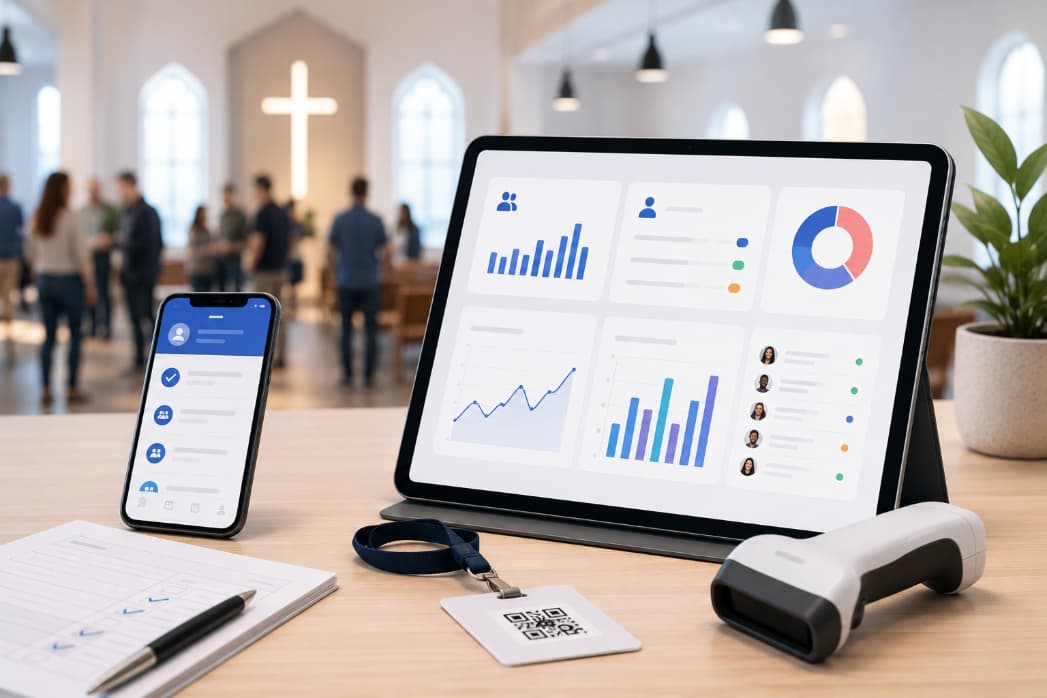
Tracking attendance shouldn't require spreadsheets, paper sign-in sheets, or hours of manual reporting. Modern church attendance tracking software helps churches record participation, identify engagement trends, improve follow-up, and gain visibility into the health of their congregation. In this guide, we'll explore why attendance tracking matters and how to choose the right solution for your chu
Church attendance is about much more than counting how many people showed up on Sunday.
Attendance tells a story about engagement, discipleship, ministry effectiveness, and the overall health of your congregation. It helps leaders identify members who are actively connected, recognize those who may be drifting away, and make informed decisions about ministries, events, and outreach efforts.
Yet many churches still rely on paper sign-in sheets, spreadsheets, or rough headcounts that provide little insight beyond a weekly number.
Modern church attendance tracking software changes that. Instead of simply recording attendance, it helps churches understand participation patterns, automate reporting, improve follow-up, and strengthen member engagement.
In this guide, we'll explore why attendance tracking matters, the challenges churches face, and the features to look for when evaluating church attendance tracking software.
Why Attendance Tracking Matters
Every church wants to know whether people are engaging with the ministry.
Attendance data helps answer important questions such as:
Are members attending consistently?
Which ministries are growing?
Which events attract the most participation?
Who may need follow-up or pastoral care?
How engaged are families and children?
Are small groups healthy and active?
Without reliable attendance data, church leaders are often forced to make decisions based on assumptions rather than facts.
A strong attendance tracking system provides visibility into what is actually happening across the church.
The Problems with Traditional Attendance TrackingPaper Sign-In SheetsPaper records are difficult to manage and easy to lose.
Volunteers must manually collect information, transfer it into spreadsheets, and compile reports. This process consumes time and often introduces errors.
Spreadsheets Become Difficult to Maintain
Spreadsheets may work for a small congregation initially, but they quickly become difficult to manage as attendance grows.
Leaders often struggle with:
Duplicate records
Missing information
Inconsistent reporting
Manual calculations
Limited historical analysis
Follow-Up Opportunities Are Missed
When attendance records are not centralized, it becomes difficult to identify members who have stopped attending regularly.
As a result, people can quietly disengage without anyone noticing.
Children's Ministry Creates Additional Complexity
Tracking children introduces additional challenges:
Classroom assignments
Capacity management
Security procedures
Parent verification
Allergy information
Pickup tracking
Managing these processes manually increases risk and administrative workload.
What Modern Church Attendance Tracking Software Should Do
The best solutions go far beyond counting attendees.
Event Attendance Tracking
A modern system should allow churches to record attendance at specific events and services.
This includes both:
Individual attendance records
Overall event attendance totals
Tracking attendance by event helps churches understand participation trends and identify which ministries resonate most with their congregation.
Check-In Functionality
Check-in systems streamline attendance recording and improve accuracy.
Instead of manually counting people, staff or volunteers can quickly locate members and record their attendance.
This creates a detailed participation history that can be used for reporting and engagement tracking.
Family Check-In
Families often attend together.
A quality attendance platform should make it easy for parents to check in multiple household members at once rather than repeating the same process for each individual.
Family check-in improves convenience while ensuring accurate attendance records.
Children's Check-In
Children's ministry requires additional safeguards.
Modern attendance tracking software should support:
Classroom assignments
Attendance records
Pickup verification
Allergy visibility
Classroom capacity management
These capabilities improve both safety and operational efficiency.
Group Attendance
Church engagement extends beyond weekend services.
Small groups, Bible studies, and ministry teams often represent some of the most important discipleship environments within a church.
Attendance tracking should include group participation so leaders can monitor engagement across the entire ministry ecosystem.
Why Attendance Analytics Matter
Collecting attendance data is only the first step.
The real value comes from turning that data into actionable insights.
Identify Engagement Trends
Attendance analytics can reveal patterns that would otherwise go unnoticed.
For example:
Consistent attendance growth
Declining participation
Seasonal trends
Event popularity
Ministry effectiveness
These insights help church leaders make more informed decisions.
Recognize At-Risk Members
One of the most valuable benefits of attendance tracking software is the ability to identify people who may be disengaging.
Rather than discovering months later that someone has stopped attending, leaders can proactively reach out when participation begins to decline.
Early intervention often leads to stronger member retention and pastoral care.
Improve Follow-Up
Attendance data creates opportunities for meaningful follow-up.
When leaders know who attended, who missed services, and who may need support, follow-up becomes more intentional and effective.
Instead of guessing who needs attention, churches can prioritize outreach based on actual participation data.
Key Features to Look For
When evaluating church attendance tracking software, look for these essential capabilities.
Automated Attendance Recording
The system should automatically calculate totals and eliminate manual math whenever possible.
Automation reduces errors and saves staff time.
Attendance Reporting
Look for reporting capabilities that provide:
Attendance trends
Event breakdowns
Participation summaries
Individual attendance histories
These reports help leaders understand church engagement at both the macro and individual levels.
Mobile Access
Church operations do not always happen behind a desk.
Mobile attendance functionality allows staff and volunteers to:
Record attendance
Check members in
Manage children's ministry
Review attendance information
from anywhere in the building.
Member Engagement Insights
The best platforms connect attendance with engagement.
Rather than showing only attendance numbers, they help leaders understand who is active, irregular, or disconnected.
This transforms attendance data into a ministry tool.
Security and Accountability
Especially in children's ministry, security features are critical.
Look for systems that support:
Secure pickup procedures
Parent verification
Classroom controls
Attendance audit trails
These safeguards help protect children and provide peace of mind for parents.
How Church Attendance Tracking Software Strengthens Ministry
Attendance software is often viewed as an administrative tool.
In reality, it supports ministry in several important ways.
Better Pastoral Care
Leaders can identify members who may need encouragement, support, or follow-up.
This creates opportunities for more intentional care.
Stronger Family Ministry
Family and children's attendance tracking helps churches better serve parents while maintaining safety and accountability.
More Effective Events
Understanding attendance patterns allows churches to improve future events and allocate resources more effectively.
Healthier Small Groups
Group attendance reporting helps leaders identify thriving groups and recognize opportunities for intervention when engagement begins to decline.
Data-Informed Leadership
Reliable attendance data gives church leaders confidence when making ministry decisions.
Instead of relying on assumptions, they can use real participation metrics to guide planning and strategy.
How Churchease Helps Churches Track Attendance
Churchease combines multiple attendance tracking approaches into a unified platform. Churches can record attendance manually, track individual event check-ins, manage children's ministry attendance, support family check-ins, monitor group participation, and analyze engagement trends from a single system. Attendance records automatically contribute to reporting and engagement insights, helping leaders move beyond simple headcounts toward meaningful ministry intelligence. The platform also supports follow-up workflows that help churches reconnect with members whose attendance patterns indicate they may be drifting away.
Final Thoughts
Church attendance tracking software is no longer just a convenience. It has become an essential tool for churches that want to understand engagement, improve follow-up, strengthen children's ministry operations, and make better decisions.
The right solution helps churches move beyond paper records and spreadsheets to gain a clear view of participation across services, events, groups, and ministries.
Most importantly, effective attendance tracking is not about numbers alone. It is about understanding people, strengthening connections, and helping church leaders care for their congregation more effectively.