The Complete Guide to Church Attendance Tracking Software
Summary
Most churches still track attendance manually — and most are losing people because of it. Church attendance tracking software changes that. This guide covers why it matters, what to look for, and how to choose the right solution for your church.
Most churches still track attendance the same way they did twenty years ago — paper sheets, clipboard rosters, and someone trying to recall faces on Monday morning. Church attendance tracking software changes that entirely: instead of guessing who showed up, you know. Instead of losing a visitor's name on a crumpled card, you have their profile, their history, and a clear next step. According to Barna Group, the typical churchgoer attends just 1.6 times per month. In a reality where most members are present less than half the time, knowing exactly who is — and who isn't — is no longer optional.
Why Attendance Tracking Matters More Than EverAttendance data is not just about counting heads — it is one of the clearest windows into congregation health.
Identify engagement patterns — who is showing up regularly, who has drifted from weekly to monthly, who has quietly stopped
Catch disengagement early — a member missing three Sundays in a row needs a phone call, not a newsletter
Support better pastoral care — context about absences lets your team reach out with intention, not guesswork
Measure real growth — not just total count, but whether visitors are becoming regular attendees
Without this data, pastoral care is reactive. With it, it becomes proactive.
The Problem with Manual Attendance TrackingPaper sign-in sheets feel harmless. In practice, they compound over time:
They are incomplete. People forget to sign in, volunteers skip it when things get busy, and kids get checked in while adults do not.
They require manual processing. Someone has to transfer names to a spreadsheet — which introduces errors and often happens days after the data is already stale.
They offer no real-time visibility. A pastor cannot quickly tell if a member has been out for a month without digging through multiple weeks of records.
They are disconnected from follow-up. A name on a sheet does not automatically trigger a welcome email or pastoral check-in. That gap is where members fall through the cracks.
What Church Attendance Tracking Software SolvesThe right church attendance tracking software eliminates the gap between showing up and being known:
Centralized records — every service and event logged in one place, accessible by authorized staff
Real-time updates — attendance captured at the door, not reconstructed on Monday
Individual-level tracking — not just "200 attended," but which 200, with history and household data
Member profile integration — attendance alongside giving records, group memberships, and contact info
The result is a complete picture of each person — not a running tally.
Check-In vs. Attendance Tracking: An Important DistinctionCheck-in is real-time and event-specific — a member scans a QR code, a volunteer taps a name, a child is logged into Kids Ministry before the service starts.
Attendance tracking is the broader layer: reporting, trends, and historical patterns. Which service draws the most visitors? Who has attended at least three times this month? How has average attendance shifted over the quarter?
Check-in feeds attendance tracking. Together they give your team visibility in the moment and strategy over time. One without the other leaves half the picture missing.
Key Features to Look ForFocus on what actually drives value:
Service-based tracking — per event, not just per week, so you can see patterns across campuses or service times
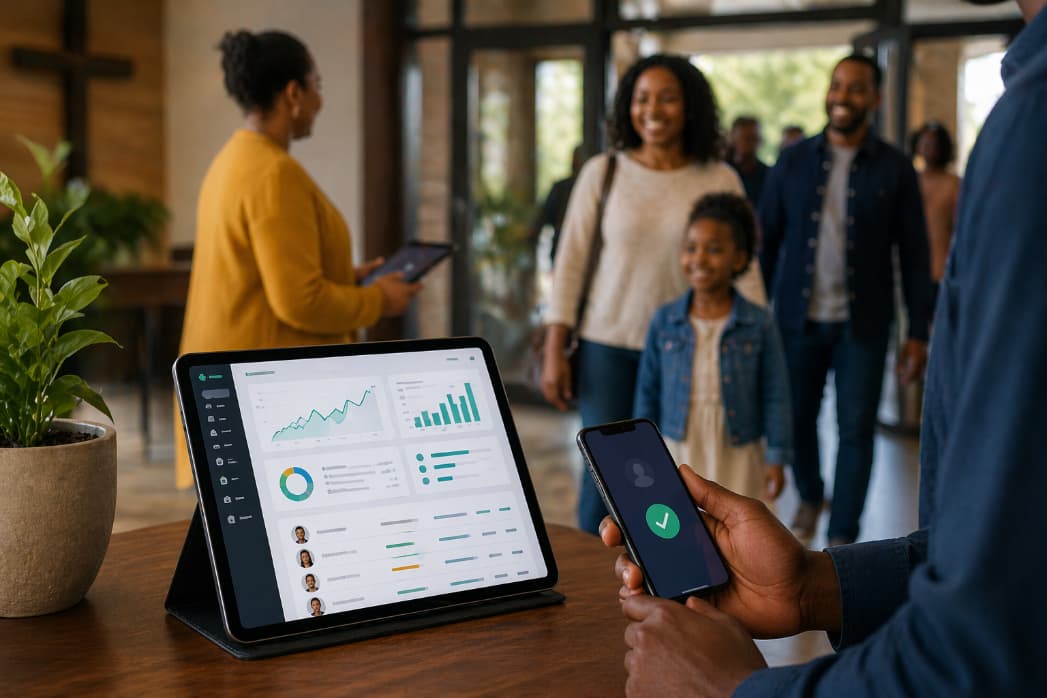
Mobile check-in — for staff and self-check-in by members, reducing door bottlenecks
Member-level history — a full attendance timeline from each person's profile
Reporting and trends — dashboards that surface insights without manual spreadsheet work
Follow-up integration — a first-time visitor automatically enters a follow-up workflow
If volunteers cannot run check-in without training, adoption will be inconsistent — and inconsistent data is almost as useless as none.
How Attendance Data Improves Church EngagementFirst-time visitors are identified immediately — flagged automatically, with a profile ready for follow-up rather than a name on a clipboard.
Repeat attendance is tracked. When a visitor returns a second or third time, your team knows. That is the moment to deepen connection before it becomes passive habit.
Disengagement is spotted early. Barna Group's research shows that even regular churchgoers attend less than half the available weekends. Without tracking, a gradual drift toward inactivity is invisible until a member has already mentally left.
Follow-up becomes targeted. Instead of a blanket newsletter, your team reaches out specifically to members who missed the last two services — personally, not generically.
Connecting Attendance to Follow-Up SystemsAttendance data is only as valuable as what you do with it. A first-time visitor should trigger a welcome sequence. A three-week absence should trigger a pastoral check-in. A new member not yet in a group should get a personal invitation — not because someone remembered, but because the system flagged it.
For practical frameworks, see 3 Simple Ways to Stop Losing Church Visitors After Their First Sunday and The Post-Easter Follow-Up System.
Tracking without follow-up is wasted data. Follow-up without tracking is guesswork.
Reducing Administrative BurdenEvery minute your staff spends entering attendance manually is a minute not spent on people. Church management software with built-in tracking eliminates that overhead and reduces human error.
A digital system removes:
Manual data entry after each service
Duplicate records from inconsistent sign-in names
Time spent reconciling paper sheets with digital records
ChurchEase embeds attendance tracking into the broader platform, so data connects directly to giving records, group memberships, and communications — no separate system, no manual transfers.
How to Choose the Right Church Attendance Tracking SoftwareIs it simple enough for volunteers? If it needs a training session to operate, Sunday morning becomes friction.
Does it support mobile check-in? A native app, not just a mobile browser.
Can it track individuals and trends? Person-level data plus patterns across weeks and months.
Does it connect to member data? Attendance should live inside the full member profile.
Will it scale? A system that works for 100 should handle 500 without a platform change.
Complexity kills adoption. Inconsistent use produces incomplete data — often worse than starting fresh. And inaccurate records lead to wrong decisions: missed follow-ups, misread trends, pastoral care gaps that go unnoticed.
The right system is simple enough for a first-time volunteer on their first Sunday and accurate enough for a pastor to trust in Monday's staff meeting.
The Future of Attendance Tracking in ChurchesPew Research Center data shows that just one-third of U.S. adults attend religious services at least once a month. As attendance patterns grow more irregular, tracking individual engagement — not just weekly totals — becomes a core operational capability.
Mobile check-in, real-time dashboards, and data-connected follow-up are not future features. They are available now. Churches that build these systems will be better positioned to identify, engage, and retain the people coming through their doors.
Attendance Is About People, Not NumbersChurch attendance tracking software exists for one reason: to help you know your congregation better so you can care for them more consistently.
Numbers on a dashboard are just the surface. Underneath is a first-time visitor from last week, a family that used to come every Sunday and has not been back in a month, a teenager who quietly stopped showing up. Tracking gives you the visibility. What you do with it is ministry.
Build the system. Stay consistent. Follow up with intention.